I proposed a dozen of questions to the artist. She was supposed to answer in written form, by e-mail. But she wouldn’t like the cold technology. She preferred a dialogue, and I was happy for that. Plato also preferred talking to his «academics» and believed that the writings were what survived of those dialogues. Teni read the questions and then asked me to talk “face to face”. The technology now permits it easily. So we took an appointment, and her temperament, her having such a sunny style, made everything easy and even funny. It was the second time that we saw each other on a screen. The first meeting, in English, was mediated by Bruno Bruni, a friend and a painter, for who I had edited two publications. I talk gladly, but I’m reserved initially. It is a sort of a discomfort that normally does not last and then I become almost terrible, but during that first meeting I guess the only impression I made was freezing. Whereas Teni seemed uninhibited. She laughed and joked. For several days, after having talked to her, I had her laughing face in front of my eyes, and it made me a bit envious.
And then, once in the afternoon, it was four o’clock in Armenia and one o’clock after lunch in Italy, we “met” again. And this time she was with an interpreter. With her first words, Teni would like to justify why she would prefer responding with “voice”. I tried to explain that I prefer direct talking, but I’m not sure I really convinced her. For the rest, the dialogue made her understand that I was of the same opinion.
The first question I asked was very dangerous, in my opinion. «What does surrealism mean for you». I’ll explain the danger. I do not consider the surrealism a movement of the twentieth century. In my opinion from the Enlightenment onwards the roles rightly separated of the intellectuals and the artists, have undergone a change, which I consider harmful. I mean an artist, not being able to resist an inner pain, produces a work of art. The artists do not reason, but let themselves go. Only afterwards they may organize what the suffering has produced, with the help of the intellect, and often this second stage damages the candour of the simple gush of the pure idea.
The movements, the -isms, born after the Enlightenment, are invented, and hence they do not belong to artists, but to intellectuals, who have usurped the role. Besides, there are great artists and herds of sheep that follow, imitating the genius. So I’m not interested in the movement known as «surrealism». I think it is represented by such valuable artists like Max Ernst, Alberto Savinio and few, very few other artists. I also believe that the word “surrealism” represents in the minds of people, fortunately not too educated, a work of an artist who tries to describe an inner reality by means of the reality perceivable not only by the senses. If you agree with this definition, which is the one preferred by the common people (and so I consider myself …) then «The Master and Margarita» by Bulgakov, the art of Chagall, «Fantasia» by Walt Disney, «A night at Bald Mountain «by Mussorgsky, «One Hundred Years of Solitude» by Marquez, «Jiurassic Park» of Spielberg and «The Metamorphosis» of Kafka, are surreal pieces, in terms that the go beyond the reality to describe the real.
It can be understood, then, that starting with this question was dangerous, but I felt compelled to an immediate and total sincerity. I always thought that the duty of a true artist, fundamental and difficult to follow, was being honest at least with oneself! So consideraning myself an artist (I write …), when speaking with another artist I can’t accept fictions which an intellectual dialogue (and its contest) presumes, and the category called surrealism, for me is an absolute fiction. So the first question would immediately unmask a fake artist, and Teni … initially felt awkward and it made me happy. She did not know how to respond. I saw a discomfort in her movements, in her not being able to sit, as if seated on the fire and then, all that tension exploded in a torrent of words pronounced with a passion. She wanted to be clear that she did not feel tied up to any of them, that she painted in that way, because she felt that way… «Painting that way, because she felt that way» – that’s the correct! This will not be a parlor dialogue full of fictions. It will not be a dialogue in the style of the Duchess of Guermantes, when you have to know to talk elegantly about nothing for hours. Immediately we got to the heart of the argument. «I have an artist before me,» I said to myself, and her being open to what her inner world offers, to the sincerity of the soul, which often surprises and dismays the artist, is the right path. Sometimes, after having finished a work, the artist turns back to look at it or to read it (as is my case) and gets very surprised. Only the greatest artists, like Kafka, Scriabin, Einstein, would not be surprised of their creations, because they have only one self inside, and not what the civil people have divided into the conscious and the subconscious
A brief premise… I quoted Kafka, Scriabin and … Einstein, and someone might think that I was wrong, or I refer to someone who should not be the famous Albert. But it’s him I referred to. I can’t stand an epoch that would close everyone into categories, into boxes which never represent a greater self. I can bring an example of the dear friend Tonino Guerra. Was he a screenwriter? A painter? A poet? A writer? When forced to answer this question, he preferred the label of a poet, but then would always tell me, «what a stupid question …». A great scientist, a Paul Nash, an Albert Einstein, offer an explanation which is a masterpiece of fantasy … and we should never forget the rule of Popper … «every theory is falsifiable.» An artist tries to describe a huge world, fascinating, scaring and makes it vibrate with emotions. The scientist is also an artist. That’s what I think. And remember that at the end of his life, Newton would describe himself as a little boy playing with shells on the beach! He said it because he was aware of the immensity, which lived and still lives outside of him. So does Teni, against certain experiences she does not feel saying «I know», just tells us continuously, by means of her art, that it could be, that it seems to her, that she hopes it is, and this involves huge issues such as love, children, death.
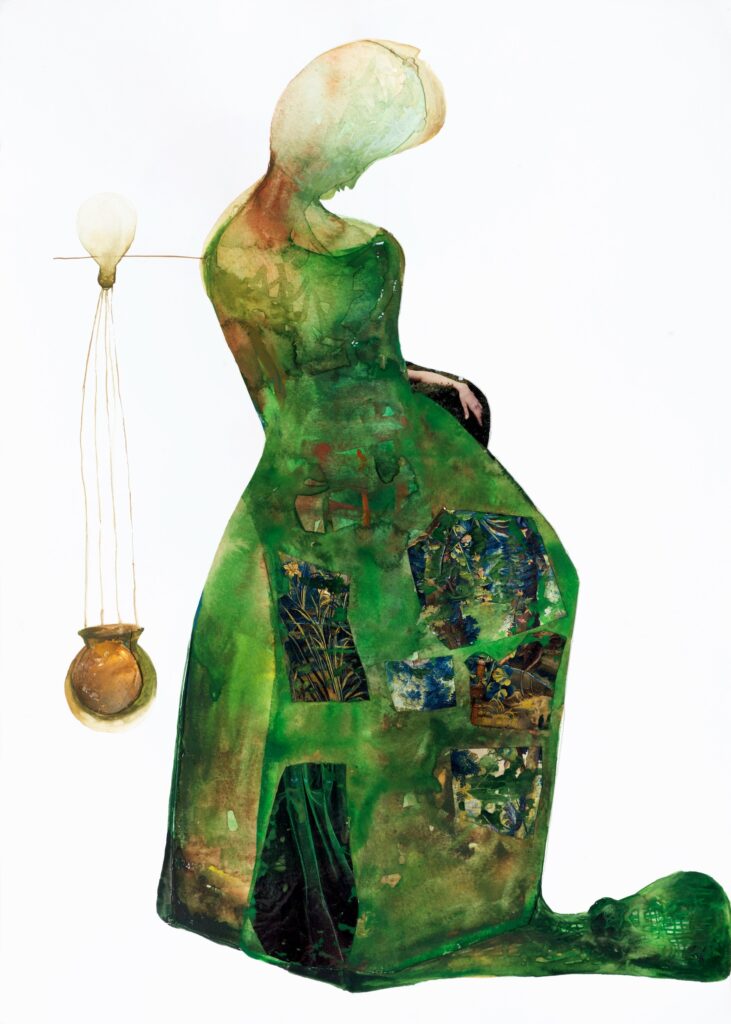
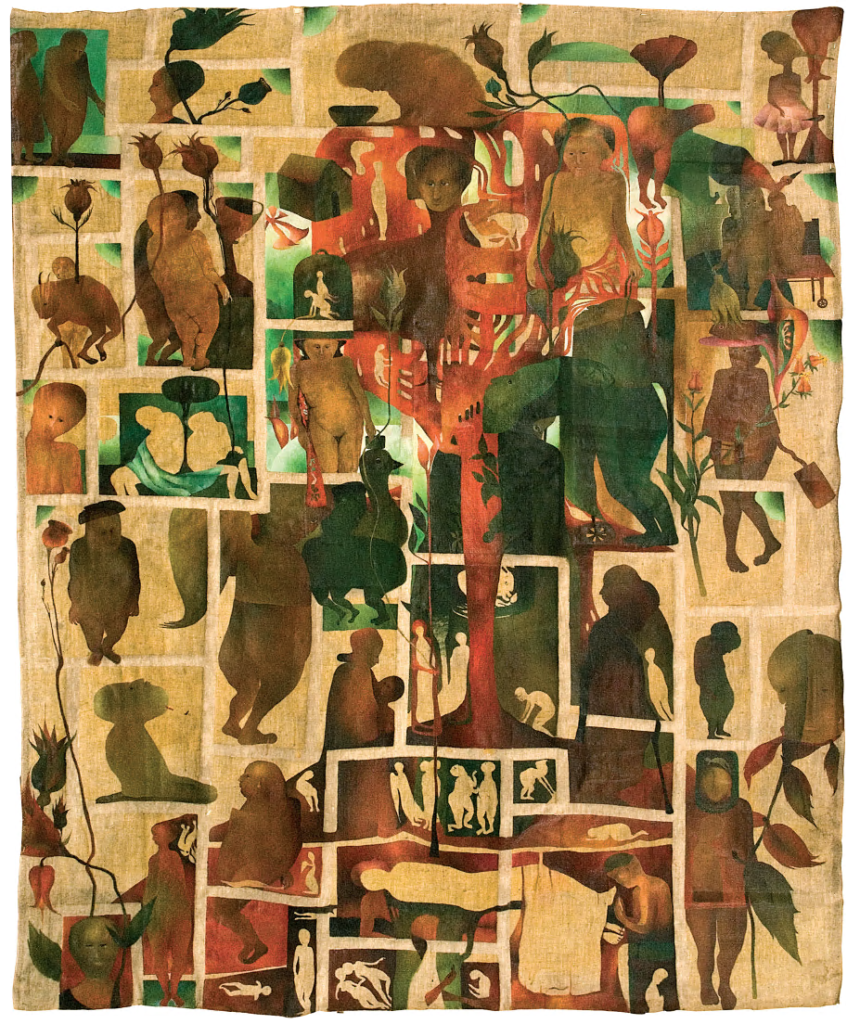
When Teni took a distance from the surrealist movement and her emotional reaction stopped, I explained what I thought of that ‹-ism. Don’t think that I have talked for ten minutes and Teni nodded in confirmation all the time. The dialogue was held in a continuous exchange of fragments that have led us to understand that, at the end of our long solitary meditations, we had arrived at the same conclusions.
At this point I told her that I had a definition, which I thought might be fine for almost all of her art pieces. «Plural pieces». I explained that she never represents a single self, but an integrity of fragments it is composed of. We are in the world. We are in a relationship with others, and I always see the ego, the self that relates with others.
She was happy with that definition. She smiled and explained her own attitude to her paintings. I had not really thought about this aspect, yet it is very important. She said, «What you have created is then your obstacle. You look forward to get free from it. And then, after some time, you miss it.»
It is interesting. Something similar happens to me too. My stories, once written, are condemned in a closed drawer. After a few months, at least six, often even a year, I take them out and read. In this gesture of mine nothing is calculated. There is no alarm above the drawer that sounds after a year. Remember that anything that an artist makes is a duty. It is an irresistible necessity. And when I re-read after all that time, I «feel» the difference between myself, which I was a year ago and which I am today. Just by reading I understand that I refined and grew up. Therefore, I have a certain tenderness towards the limits of that self that no longer exists, and if I finish the reading, it means that in any case I don’t despise what that immature being had created. Do not be surprised if I try to express Teni’s inner world and mine too. To you, who read, the two are mysteries and one is an intention. You move between two strangers, Teni and me, with the intention to «understand» something of the paintings of this artist, who is not of an immediate comprehension. Teni has answers for the person, who has to reveal something of himself to make you understand, at least a little bit, why he preferred this question and not another one. Only in this way you’ll have a chance, at the end of the reading, to get a feeling of some light. If I remain anonymous, I become a not-human judge, I become obnoxious. Maybe that’s the impression I leave anyway, but at least I’ve tried to get down from that ridiculous pedestal of the art critic. Diderot said it’s a role that only another artist is able to accomplish with respect.
I wrote the word «understand» in reverted quotes and that at the end of the phrase you might get a feeling of some light. It’s an important passage. In art no «understanding» exists in the meaning we imply. In art the words cannot be definitive. There is a feeling that can be reached, which embraces the whole effort of the artist, a feeling, which, without becoming logical or consistent, is still able to nourish the soul. Remember, for example, that the language of a true art is presented by symbols. Rational thinking can build it, but it’ll look fake. A true symbol passes through epochs, through thousands of years, it is more foggy than a phrase, but more complete. And, let’s never forget about the soul, the soul which the science denies, which is sometimes called the subconscious, and other times – an inner self.
Another curiosity that arose during observation of Teni’s paintings, was to understand what religion was for her and how she lived it. There is no doubt that she’s quite familiar with it and often uses cultural symbols of suffering, comprehensible for the whole Western culture. This curiosity of mine was preceded by another and then they merged together. I am an avid collector of dreams and when I gain a bit of confidence with someone, I ask if they will tell me one. Teni described to me a recurring dream, which for many years, she wouldn’t remember since when, was accompanying her and recently had reappeared. «A church, a crowd of people in the yard, people are all in line and want to enter. I am also part of the queue. When I enter I see an angel. She is holding a roll of canvas. She is reaching out that piece of canvas to me and I see an eye painted on it. I’m fascinated with that eye and hear voices of kids outside in the courtyard of the church.» Her description was so immaterial, the sentences so short. It was obvious that she had that dream running in front of her eyes as a movie. Then she said that that eye was constantly in her mind. She realized that she did not understand it completely.
I’ll try to put down what we may try to interpret from her dream.
A dream has an outside and an inside. The inside of the church is the soul and its messenger is the angel. Many want to come in, she is also in line and receives her gift. I think every one of the people in line will receive from the angel the same canvas with the eye, which is surely the one of God.
A noise from outside distracts her and she wakes up. I think this detail has really happened, I mean probably one of the first times she had that dream, the voice of children woke up Teni. I also think, and I know I may be mistaken, that the Teni who dreams the church and the eye for the first time, is still a little child. Perhaps it is the period of life when the body is already a woman, but the heart still chirps, and when she hears her peers chirping in the street, she’d like to run out to play.
I placed the dream in the time of her birth, now we come to the essence.
The divine message is given when one is a child. We learn, but do not understand it. There comes a moment in life when you want to understand, something is totally wrong with religions, accepted or refused. We are born and educated in the world of concrete and daily logic. If I let go an apple, it’ll fall to the ground, and it’ll be sufficient for me to see it happen again and again to decide that this is the reality. So the repetition of a fact is enough to decide what is real and … scientific. Hume said that the opposite does not belong to the everyday life, but to the dreams of the science! A person, who has learned to live with this way of rational, in a certain way useful thinking, never touching God and angels, that person, at the beginning believes in Santa Claus like others believe in God. Then Santa Claus «dies», and God has to face arguments strongly limiting his survival. Believing in God becomes difficult, because our mental rule, which is fine for apples falling here on our planet and for Newton, is not enough any more to make us believe in God. Then the discovery of the death intervenes, which is madly intolerable, and which, particularly for a woman, could become distressing, for the feeling, actually for the certainty of being the one who concieves life. Religions may say thousands of times a day that the life is of God and that he gives and takes it when he wants! The feeling of a woman, who first blooms to the beauty and being beautiful, inebriates with the joy of living, and then breeds a seed in her body, which grows into a child, this feeling distances her from the idea that the life is a divine gift. Life gets sown and blooms inside of her. Comes out of her! And the anguish of her son›s death makes her different from a male, who lives only the anxiety of individual extermination. Often, too often, a father looks at his son as at the continuity of himself, a mortgage to the eternity. That’s why men are obsessed with paternity and are willing to spend a fortune on the analysis, which would prove, leaving no doubt that he is really the biologic father! For a woman … for a woman the son is a flower to grow, is a vastness, which is detached and lives and lives on. And the idea that death would destroy the fruit of her own creation is scary. I believe that in nature there is only one thing against nature, and it is the case of a child dying before the mother.
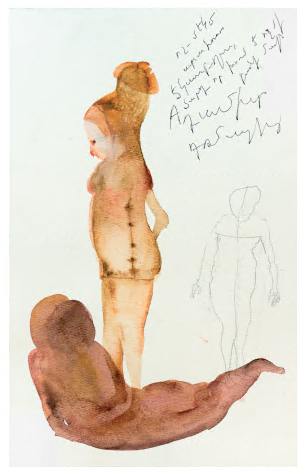
Why I explain these things … because through talking with Teni about her dream, we unmasked this anguish. I had intuited. She told me to love the religious functions. She didn’t attend them any more, but lived them inside of herself. She didn’t know whether to feel guilty, and in order to make her less guilty, I told her about Alberto Savinio. This great man was on a holiday with his family at the seaside, (I know the daughter, Angelica, and I had a confirmation of what I’m telling now). Alberto used to go out early in the morning, to take a coffee and a newspaper and then return home. The family prepared quietly and went down to the beach. One day a friend asked him: «Why don’t you ever come to the sea?», and he replied: «If you have more than forty years, like me, and if you knew how to live them, you›ve got the sea inside.» A wonderful answer. «Teni» I said, «the same is for you! You now have the religious functions inside. You even dream them repeatedly! What’s the use of taking the body to a place, which would probably distract you with the daily reality and reveal lots of meanness?» I then explained that now I don’t go to listen to violins and pianos, to some extent due to the perfection of Glenn Gould and to some extent due to the excessive emotionality of concert halls. Once in Salzburg, I heard a concert that seemed gorgeous. The next day a friend brought me the recording and I listened to it, but, far from the evening gowns and thousands of, often very tiny distractions, I realized that the day before I had witnessed something truly mediocre. Now I love to wait until it’s dark and I’m alone. I light up a candle and turn on the music and, in the stillness of the body without distractions, (I also hear the ticking of the heart …), I manage to get in harmony with the music, with its composer, with the player, with the soul of the world! So do you, Teni, in your dream you are distracted from the angel and from the message because the children are playing outside! A church of flesh and bricks is not enough for you any more. The place you are searching is more sacred, and holy is the silence, which probably would have revealed that the angel, while giving you eternally the canvas, was saying some very important words. Or maybe the angel was smiling, because if there is noise, even the smiles you see less, and an angel who smiles is an open door, is a marked path.
To make explicit this fear of death of those who we have created, I suggested a «play» to Teni. «Imagine a house,» I said, «the house, where you were born and where you lived so long. Now you have inherited it. You go in and walk alone, from room to room. At some point you find a door behind a cabinet which you absolutely don’t remember. You decide to move the cabinet and open it … what do you find behind it?»
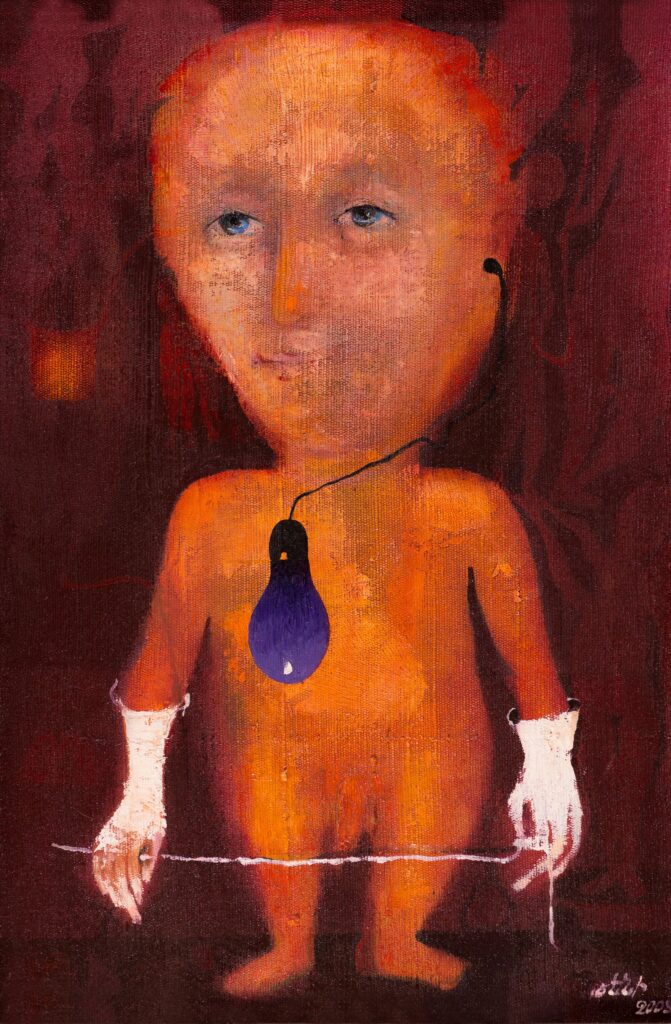
A note for the reader – this «play» requires one condition to work. You must not think, but see, observe the first image that appears inside yourself. Only that imagining has significance. With Teni I had no need to say it. She, like Bruno Bruni, is immediate.
But Teni wouldn’t respond … she stiffened. I saw her in an extreme anxiety. She told me she would prefer not to answer. «That’s fine,» I told her. «Not wanting to answer is also an answer in its essence…». And at this point she said, with some agitation, that she’d like to see everyone in that room.
Here›s the essence. A world without death. The being which creates life and that does not accept the end of what she has created. She explains that she has children. She had loved and that he›s gone … that she can’t resist, but resists what she wouldn’t say. Here›s the heart, her beating heart in front of me, radiating with light, and no body. Here is a being turned into a desire, which swallows her fears and chews them slowly. Here›s the artist …
That plural fire of her paintings, so colorful, where the self is one’s proper being and those who you love… and the fear that everything will end. A sense of ennormous responsibility. Giving birth is condemning to death …
To loosen her tension I explain to her a thing of Damien Hirst, who I love as a toothache. A friend, Claudio Franchi, had interviewed and attended him while in London. He is an artist-craftsman, of a high level. For example, he has made the signet of the Pope. When in London, sometimes I went to the pub Hirst frequented. I met him and we talked a little. A great fiction. A colossal commercial deal. He smiled and told me that sooner or later I would find out, and you could tell that he was afraid. A «commercial artist», an absurd paradox invented by Warhol, should not fear the thought! The Artist and business do not mix together. The pearl is a pain for an oyster. For others, not for her, it is a gem! The artist, the real one, creates even if gaining nothing. Creates because he/she can’t help it, just like the oyster, which has to defend itself from that smallest thing that entered its body and that hurts it. Hirst will not be disclosed, as he is afraid of, since he belongs to the market and not to the art. But one obsession we find in his art, and that’s the death, which he does not accept and can’t stand. Three pieces are just jokes, which I consider too trivial to be remembered. Do you remember the shark in formaldehyde? It was born of a bet. He had declared and bet that nowadays everything can be bought, that the trade was now global. He had the challenge to get a shark, with lots of difficulties, but finally it arrived from Australia… how sad! «You see Teni» I said, «your fear of death is in controversy with religion, is a triumph of motherhood, of love you lived with your man! Your fear of the end is not yours, but is for those who are around you! For the one you love! In your paintings the joy of feelings and of affections come first! It is not your death, it’s not your end that haunts you! You live it as a very old issue not projected on yourself! It is not selfish! In the Western culture, the family is now reduced to a minimum. In some cultures it is now only an appearance. There is no stability in the relationships, so the inner self is always alone. This huge, intrusive self, which is never sufficient, because of our need to love and be loved, because it can’t get satisfaction in a compulsive and strongly egocentric shopping!»
Teni smiled and thanked me. She didn’t expect a confrontation with Hirst, neither getting out of it successfully. At this point I asked her, which memories she loved most, and she began describing the house of her childhood, the large tandoor, the smell of bread that often returned to her. This reminds me of Federico Fellini, who often felt the smell of passatelli, the tastiest food of his native land. When in the study of his house in Rome, sitting alone, a slight melancholy would invade him and then a gentle smell of childhood would drive it away … see Teni, if you open your inner self, whatever is deposited in it, even in the very depth, whether suffering or a smell of bread or passatelli, everything returns. And an artist, who creates paintings, putting all her past around her, collects not the smell of bread, which unfortunately can’t be represented in the painting (nether the smell of passatelli in cinema…), but a feeling, a state of mind, that the bread, that divine meal ever since man exists, the gift of Demeter and of Jesus, is not enough to exorcise the end of what we love … Here’s Teni. That’s what I feel shining through her paintings.