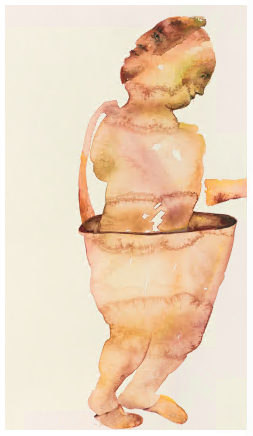
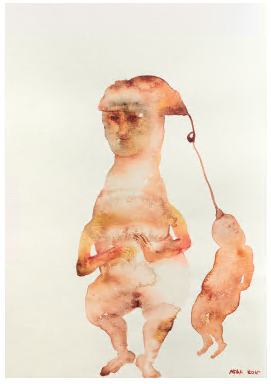
I had other ideas regarding Teni’s paintings, but I couldn’t put them in words. I needed a moment of meditation. I think I have understood what had happened. Teni uses two categories of symbols. The ones, which belong to her deeper self, also called by the experts “archetypal symbols”, and the cultural ones. Even though she definitely prefers the latter, and remember that the choice is not consious (it’s the heart that chooses), the most deeply rooted cultural language, ancient and multylayered, a couple of thousand years old, I mean that of the religion, in which she was born and grew up. Let’s see the cross, for example. It represents the moment of Jesus’s agony, but in a more archaic sense, in a sense of which we are not consciously aware, unless in the oldest swamp of our inner self… in that far away swamp (far from the mind, but not from the heart). We can understand it playing a simple child›s game. In front of the short arms two little hands are drawn, something childish, as would a six year old child do. In the upper part of the painting a face is drawn. And it’s here that the cross becomes a human being with wide open arms. If you think of the origin of the welcome gesture, when the right hand searched the other person’s hand and shook it. This gesture would show that the hand was not armed, that the person had no intention to hurt and requested the other person to show his hand too, to get the same certainty. Now, that cross, which in ancient times, prior to Christianity, was a human being, who opened to another human standing in front, was the monument of sociability, a symbol of sincerity. Jesus was a social being to the highest extent, and his conviction, on the symbol of confidence towards the other person, will make a different effect on you now. These words disclose a symbol of an immense importance to you. I knew it was time to tell her these things, but they were not enough for me, something was missing. I would say their meaning was interrupted. You had to go deeper, and here today, reading a book by an Italian writer, I found a phrase that made me realize what I couldn’t say, what I couldn’t turn from Teni’s symbol into words. It is Dolores Prato, a writer hardly known even among Italians. On page 195 of her most important book she writes: «Who really forgives doesn›t remember the sin any more.» After a good dose of self-examination I re-emerged with an “eureka” as Archimedes and I said “this is Teni’s meaning that I couldn’t explain.” You shouldn’t seek forgiveness or sin in Teni’s paintings because there they aren’t. There is a joy for life, for the being for others, in the others, in those you love, that’s why the symbol of the cross in her is not only Christological, but it goes deeper to the roots, and the religion, in which she’s lived, sums up there, it’s because certain layers, certain crusts don’t come off easily and then we resign and let them stay. And in the end, the fact of its presence, the fact that you see it, is not grievous. In his letters of January 25, 1720, a certain Johann Sebastian Bach wrote to a certain Isaac Newton: “I try to write music for myself, sir. It’s the most difficult of tasks.”
If it seems nothing to you, just try to think of that epoch when crafts only had sales and the more you earned, the more important you were considered. This approach, Johann Sebastian teaches us, is difficult to achieve and to live every day. But Teni does. She forgets the daily duty and indulges herself, stops and listens to her inner self, which can’t talk, but throws out symbols, which then Teni organizes on the canvas. At another point that great letter reads «… I believe that the pinnacle of the art is achieved when the rationality and the creative impulse merge, enhancing each other.» Just think that even Bach was not faithful to this meaning, which I believe in. In him the rationale had often dominated the creativity, but a pieace like the “Air on the G String» is profoundly faithful to what he wrote. The opposite happens in Teni’s case: here the creative impulse dominates and the rationality acts calmly. It is normal, if you consider how much damage this rationality has made, which from the Enlightenment onwards had dictated the law to the human being, supposed to be without feelings!
Another Italian writer offers a phrase that helps to complete what I tried to say. Anna Maria Ortese in her «The plumed hat» writes (page 264):
«From the separation of feeling and reasoning, of reasoning and acting the anguish was born.» The sentence was written in the seventies of the twentieth century. It describes an epoch, when the self was not comprehended, and now we can find our reflection in there and try to heal. In the end, the artists serve for this too…The word «feel” derives from feeling. Reasoning is a different thing, useful, but not when alone, and if it acts without feeling, it blocks the action, the life, and you get sick, for the anguish is a sickness.
Just think, apart from everything, even science, more slowly, has reached this conclusion and if it took more time, than to the artists, it’s due to the fact that the theoretical science is a slave of the rules it sets, hence of the secular dogmas, while the empirical, for example medicine, is forced to admit the evidence. Antonio Damasio, an excellent Neurologist, concluded, after a lifetime of study, that the areas of the brain which «contain» the rational capacity, “contain” the emotional capacity too. Therefore saying that emotions are the heart and the intelligence in the brain, as we are used to, is wrong. The heart is intelligent as well, or, if you prefer, the brain also has a heart and living a normal life is impossible both for the one, who is all the heart, and for the one who is the pure ratio.
Teni prefers feeling. She wouldn’t discuss even the limits of reason. For her it would be like saying that water is wet and it makes no sense wasting time discussing the obvious. You must instead try to make sense of existence and this requires … the heart.
To close up I’ll quote from Kurt Godel: «the probability is a weaker concept than the truth.» A short sentence, which he obviously applied to mathematics, but I think it is applicable to everything. Consider that … even such a pure concept, as the mathematics, recognizes that proving a concept is not enough to reveal the truth … let’s try to apply this thought to bigger and smaller doubts of life. The existence of God can’t be demonstrated, even if Kant tried to, and was even convinced to have succeeded. No truth is ever final in love, in any kind of love, and only living, opening oneslf, as the symbol of the primordial crucifix, leads us to a result, which is not a rational demonstration, but a «feeling the life”, which only in this way is justified. Words can only go close to the core of existence. The brush is also condemned, but the limits, which are defined by the symbol, bring to a dimension, either inside or outside, which awards with the a sense of significance that life exists, that love exists, that God exists, and we are in him.
Werner Bertolotti
Writer, art critic